Saturday, April 7, 2018

Camilla's Roses

Camilla's RosesCamilla's Roses by Bernice L. McFadden
My rating: 5 of 5 stars

There was a lot of pain in this story. The mother of the girls in the family gave each one a middle name of "Rose." First there was Maggie Rose who never seemed to grow up even after a tragic automobile accident that killed Lloyd, the love of her life. And there was Audrey Rose who could not shake her addiction. The mother, Velma was never able to give Audrey the help she needed and abandoned her emotionally. The father, Chuck tried his hardest to lead Audrey on the right path. Sometimes it's the Dad who loves that child "in spite of."

Audrey got married and bore a baby-girl, Camilla, who should have been the love of Audrey's life. But it was always Velma who did the most for Camilla, while Audrey was doing drugs, stealing anything that could bring a little money, in the street, in prison, while Camilla was watching it all.

Camilla was the smart one, got good grades in school, and went off to a major college. But she could not shake the presence of Audrey from her life. Camilla was fair-skinned to start with, but bleached her skin to remove the presence of Audrey from Camilla's psyche. Camilla married and moved to the suburbs with her husband and baby Zola. When she got cancer, the husband stopped being attentive and cheated on Camilla with one of her best friends.

And then there was the backdrop of September 11, 2001. The whole world was watching. Camilla gathered up her wigs and her baby and went HOME! Home to mother Velma and sister Maggie.


View all my reviews

Wednesday, March 28, 2018

An American Marriage

An American Marriage by Tayari Jones
My rating: 5 of 5 stars

An American Marriage"An American Marriage" or "American Tragedy" or "American Triangle?" And it happened in the Piney Woods. Roy and Celestial decided not to stay at his Mama's house that night and went instead to the Piney Woods, where Roy went to get a bucket of ice and ran into a woman who needed help with her ice due to a rotator cuff. Roy cautioned her to lock the door, and he left. Then another man opened the door and raped the woman.

After weeks of motions and depositions, Roy slept behind bars 100 nights before he was brought to trial, and the woman could not identify Roy...sent to prison for 15 years, an innocent man.

The story continues with chapters back and forth between Roy and Celestial, both hopeful that Roy will be vindicated. The years go on weighing on both of them, a difficult time to be going to visit Roy in prison, until he tells Celestial not to come anymore.

And then after five years of depositions with the help of "Uncle Banks," Roy is released and doesn't know what to do with his life. During that time his mother, Olive has died, Celestial and her friend Andre have attended the funeral and burial.

I had a tearful time when Celestial sang "Jesus Promised me a Home." I had to dig up Jennifer Hudson to listen to the song a few times.

When "Big Roy" stayed to bury Olive without the help of the crew of men provided, himself using only a shovel, Celestial and Andre stayed until Olive was sufficiently buried.

Finally Roy is released, and goes to Big Roy's house to decide how his life should proceed. He still has a wife and struggles with his relationship with Celestial as well as with Andre.

There were some gut-wrenching scenes before it was all over, and Roy finally gave in to continue his own life.


View all my reviews

Monday, January 2, 2017

Small Great Things

Small Great ThingsSmall Great Things by Jodi Picoult
My rating: 5 of 5 stars

BEFORE I READ THIS BOOK:
I just picked up this book yesterday (December 23, 2016) from the library, the Large Print edition. (The large print editions are usually available more quickly than the regular print.) My "white ladies book club" asked me to lead the discussion for this book when we meet in January. ("Damned if I do, damned if I don't. So I agreed, dammit.) The story centers around, Ruth Jefferson, a black Labor and Delivery nurse who does her routine checkup of a newborn, whose parents are white supremacists and don't want her to touch their child.

I hope the story doesn't evolve the way many novels by white authors attempting to tell of the black experience often do. Jodi Picoult has many best-selling novels under her belt, so maybe I can trust her "chops."

NOW THAT I HAVE FINISHED READING THIS BOOK.
I have to praise Jodi Picoult for her research. If you read the "Author's Note" at the end of the book, you will see that she does not take the subject of racism lightly. She recognizes her own "white privilege" and has taken great pains to do the research and educate herself about the differences in black culture and everyday life. Picoult reached out to numerous black women to educate herself, and enrolled in a social justice workshop called Undoing Racism, to "peel back the veneer of 'who I thought I was from who I truly am.'"

And then there is the whole Neo-Nazi culture. She did her research there too on the white power groups who believe in the separation of the races.

Jodi Picoult is not Kathryn Stockett, the author of "The Help," whose simplistic view of racism offended a lot of black people.

Now for the story, without giving away too much. Ruth Jefferson is a black Labor and Delivery nurse, who is told by her supervisor that the white supremacist parents of the newborn she is checking, don't want her to touch the baby. When the baby subsequently dies, the parents accuse Ruth of murder.

Ruth, who has worked over 20 years in Labor and Delivery at that hospital, is fired from the job, and is arrested in the middle of the night at her home where she lives with her A-student son, Edison, only child of Ruth's late husband who lost his life while deployed in Afghanistan.

Ruth has no resources to hire an attorney, but requests the services of a public defender, Ms. Kennedy McQuarrie, who takes her case. Kennedy lives the life of "white privilege" with little understanding of what "people of color" experience on a daily basis. Ruth and Kennedy have to gain each other's trust, and come to understand what their lives mean to each other.

The scenes of Ruth in jail, then released to find work at McDonald's were heart-breaking. Her son starts to act out, while he tries to make sense of his life, and his future with his mother's life in jeopardy.

Picoult tells the story with back and forth chapters of Ruth, Kennedy, and Turk, the white supremacist. It was difficult to see Ruth in a state of depression. Kennedy stayed on the case and tried to come to an understanding of the daily life of African Americans. The Neo-Nazi chapters were very disturbing.

When we come to the trial, the action is a page-turner. No spoilers here. As I often say, "you have to read it for yourself."

View all my reviews

Saturday, November 12, 2016

Ordinary GraceOrdinary Grace by William Kent Krueger
My rating: 4 of 5 stars

This was another book club selection, following on the heals of "Peace Like a River." The common thread in the two books is faith, and belief in God during a summer in New Bremen, Minnesota, when too many people died. The story is told by young Frank Drum looking back over the years when he "came of age." Frank and his younger brother Jake, mostly inseparable through that summer, found themselves burying a young friend, an unknown "itinerant," and their sister Ariel.

The story unfolded against the backdrop of wealth and privilege of two households of the Brandt family. The older Brandts, Axel and Julia Brandt, owned the brewery in New Bremen which had prospered for more than a hundred years. Emil Brandt was Frank's mother Ruth's good friend since childhood, and a talented musician. Lise Brandt was Emil's younger sister, born deaf and subject to fits of rage. When Emil returns from the war, blind and facially disfigured, it is Lise who takes care of her brother. Lise and Jake, who stutters when he is with strangers, forge a bond. They understand each other even through Lise's deafness.

Nathan Drum, father of Frank and Jake, had studied law, and expected to become an attorney before the war interrupted his life, and the expectations of his wife Ruth. When Nathan returned from the war, he had no interest in law, and chose to become a minister, much to Ruth's dismay.

It is Nathan's gentle nature and unwavering faith that keeps his family together even during the darkest times of their lives. The mysterious death of Ariel shakes them all, and it is Frank and Jake who gradually solve the mystery.


It was a good read. I think my book club will enjoy this one much more than "Peace Like a River." I won't tell how it ended.


View all my reviews

Tuesday, October 18, 2016

News of the World

News of the WorldNews of the World by Paulette Jiles
My rating: 5 of 5 stars

Awesome little book of 209 pages. It reminded me a bit of True Grit, except that Jefferson Kyle Kidd is not a drunkard. When we meet him, he has lived through three wars and has reached his seventies. His new "job" has made him a reader of newspapers and journals from all over the world. He earns his living from the coins he receives from the people who gather in various masonic lodges, churches, etc. to listen to Kidd's reports of News of the World. At one of his stops he is offered a fifty-dollar gold piece to return an ten-year-old orphan to her remaining relatives near San Antonio. She is the only survivor after Kiowa raiders slaughtered her parents and sister, leaving a little blond-haired girl to be raised by the Kiowa.

It's a long trail from Wichita Falls to San Antonio, but Kidd takes the job of transporting Johanna, who has lost understanding of the English language, to her relatives, who are German. Johanna has spent four years as a Kiowa, and at first she tries to run away back to them. Over the months of their journey, Kidd learns from Johanna, and Johanna learns from him. She learns some English and Kidd learns the ways of the Kiowa. "All animals are food, except for horses."

Kidd continues his readings along the four-hundred-mile journey, his only income. They must watch for thieves, Comanches and Kiowas. Johanna proves how resourceful and feisty she is and develops an attachment to "Kep-dun" Kidd.

No spoilers here, but the story will tear at your heart.

View all my reviews

Monday, September 5, 2016

The Underground Railroad

The Underground RailroadThe Underground Railroad by Colson Whitehead
My rating: 5 of 5 stars

Colson Whitehead is one of the novelists whose books I have been meaning to read, but I couldn't quite pin down his genre. Besides being a Pulitzer Prize finalist, he also has a book about zombies. So when The Underground Railroad appeared (even before Oprah put her badge on it), I decided this was the time for me to read this book.

But did I ever have a "Wayminute" moment. By the time I got into the book I realized this was not the Underground Railroad I learned about during "Negro History Week" in seventh grade from a teacher who ignored the official curriculum and taught us about the way runaways were transported through cellars and hidden in attics to escape to the "free states." What we learned about was the "virtual" railroad. Whitehead's railroad is a physical railroad with a real train and conductors.

The story centers around Cora, an orphaned child whose mother had escaped the Randall plantation in Georgia, never to be seen again. When Cora is older she escapes to South Carolina, where she is given a new name, a job as a housekeeper, and lodging in a dormitory with other young women. This is all through a project financed by the US Government. And I thought zombies were far out.

Cora's nemesis is a relentless slave-catcher named Ridgeway. When she thinks she has gotten away, there he is again, ready to return her to Georgia.

There are some fascinating twist and turns throughout the story, some giving real hope for Cora.

View all my reviews

Wednesday, July 13, 2016

Homegoing

HomegoingHomegoing by Yaa Gyasi
My rating: 5 of 5 stars

I loved this book, but because I had to return it to the public library, I had to copy the family tree at the beginning of the book to help me remember all of the people.

The story takes us from 18th century Ghana, back and forth across the Atlantic to follow the lives of the descendants of two half-sisters, children of "Big Man," the Chief of the Asante. The chapters go back and forth from one side of the family tree to the other, from Ghana to the U.S. and back so that we see history unfold for slaves in the U.S. while the wars between tribes direct the slave trade from Gold Coast to the Americas.

We read of the migration of former slaves to the North, to Baltimore, Harlem and beyond. To the convict leasing system in the coal mines. To the impact of heroin addiction, the war on drugs.

On the African side of the family tree, we read of James Richard Collins who changes the path of the Chief by marrying for love. Each chapter is a new story taking us closer to the present time.

The Author was born in Ghana, but grew up in Alabama. The book was well-researched to give the reader a full understanding of the history on both sides of the Atlantic. An awesome task.


View all my reviews

Friday, May 20, 2016

The Book of Harlan

The Book of HarlanThe Book of Harlan by Bernice L. McFadden
My rating: 5 of 5 stars

Can we say six stars? This is Bernice L. McFadden's best book ever! Her prose is stunning, gliding over an epic of horrific proportions.

We meet Harlan's parents Sam Elliot, and Emma Robinson before he was conceived, while Emma was too innocent to protect herself. But they did the best they could, leaving Harlan with his doting grandmother while the young couple goes off seeking their fortune from Macon to Louisville to Michigan, returning home to Macon when Emma's father Tenant Robinson dies. When Tenant's estate is settled, Emma and Sam move on to Harlem where Emma's best friend Lucille a famous blues singer, has settled in a large home, with rooms to spare.

McFadden weaves her story around historical facts of life in Harlem with famous singers and musicians of the 1920's. When Emma and Sam go back to get Harlan to join them in Harlem, he is at first defiant, but goes with his parents to New York where he discovers a life he never imagined. When Harlan learns to play the guitar, Lucille invites him to go on the road with her. But Harlan, who never has any personal discipline was often late, or drunk, until Lucille has to fire him and send him home.

Harlan lacked discipline, but he did love the music enough to form a jazz band. He found his partner in music in one Leo "Lizard" Rubenstein, who could play trumpet like Satchmo. Harlan called him his "brother from another mother." The band was invited to play in L'Escadrille in Montmarte in Paris. And so they went. Harlan, still lacking discipline, had a wild partying time in Paris, not aware of the Nazi invasion of France. (No spoilers here, it's in the book-blurb.)

McFadden continues the heartbreaking part of the story, leaving me in tears. The story ends in the 1960's, the Viet Nam War, "riots" in the cities, Imamu Amiri Baraka (Leroi Jones), "free love." And a wonderful denouement.


View all my reviews

Wednesday, May 11, 2016

Brooklyn

Brooklyn Brooklyn by Colm Tóibín
My rating: 4 of 5 stars

This was a selection from one of my book clubs, selected after it was made into a movie, and nominated for an Oscar. The movie didn't win, but many of the book club members saw the movie and read the book. Some read it before seeing the movie. I'm glad I read the book first.

Brooklyn is a coming-of-age story of young Eilis Lacey, whose sister along with a Priest recognizes there is little work in Ireland for a young woman, and help her to migrate to the US. The Priest helps her find a room in a rooming house, a job at department store, and entry into night school.

Eilis (it took me about a chapter before I stopped thinking her name was "Ellis." More on that later)...Eilis finds love at one of the weekly dances at the parish. Tragedy strikes the family back home in Ireland and Eilis goes home to help her mother for a few weeks.

I found the book to be rather slow moving, tedious at some points. The author is not specific about some of the details, and leaves it to the reader to wonder.

The movie, on the other hand, moved over a lot of the tedious moments as when Eilis was lonely and seriously homesick, before she met Tony. She was less of a tragic figure than the Eilis of the book.

The ending of the book was rife with conversations that were more "signifying" than specific, and made me wonder how Eilis would proceed. Those same conversations in the movie were direct and left no question of how Eilis would proceed.

I did love the Irish brogue. Eilis is pronounced "Eye-lish." And the singing of the down-trodden old men at the Christmas dinner was heart-breaking.

I give the book four stars. The movie I rate as five.


View all my reviews

Tuesday, May 3, 2016

It Happened in Eighty-Eight (Eighty-Eight, #1)It Happened in Eighty-Eight by Bettye Griffin
My rating: 4 of 5 stars

Cornell Sebastian returns to the fictitious town of Eighty-Eight, Mississippi to handle the house her late uncle has willed to her. She hires kitchen and bath designer Ajay Vincent to upgrade the kitchen and spruce up the rest of the house. Ajay is enchanted by Cornell, takes her to meet his friends and family in the little town, and romance begins.

Cornell and Ajay both have secrets that make them "damaged goods." Ajay doesn't give up on Cornell who freezes up every time he touches her, even though she wants to be in a relationship with him. When she finally tells him her secret, it lifts a burden from Cornell but adds to the weight for Ajay who has his own secret.

I guessed Cornell's secret from the first time it was implied. Ajay's secret was more complicated.

It was a good read.

View all my reviews

Wednesday, April 13, 2016

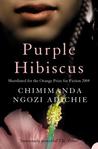
Purple Hibiscus

Purple HibiscusPurple Hibiscus by Chimamanda Ngozi Adichie
My rating: 5 of 5 stars

Kambili and Jaja Achike live what seems to be a privileged life. But their father Eugene is tyrannical, controlling and abusive. He is respected in their Catholic church due to his wealth and position in the community, owning a newspaper, and several factories that produce various goods. But he refuses to allow his father to enter his house because Eugene considers him a "heathen" who holds on to his traditional African ways, refusing to become a Catholic.

Kambili and Jaja live in fear of their father who insists that both of his children must have the highest grades in their respective classes in Catholic school. They are both smart students, but when Kambili brings home her grades as the second highest in her class, she is whipped for that transgression.

Eugene's sister Ifeoma is a lecturer in the University at Nsukka several hours away from Eugene's family in Enugu. Aunty Ifeoma recognizes her brother's controlling and abusive nature, and invites Kambili and Jaja for a visit during the holidays. Aunty does not tell Eugene that the children will also visit their grandfather who lives in a traditional village. Kambili and Jaja's eyes are opened to a different way of living in Aunty's house, and Kambili finds her own voice, and her own freedom.

View all my reviews

Friday, March 25, 2016

Baby Girl

Baby Girl (Memory House Collection, #4)Baby Girl by Bette Lee Crosby
My rating: 4 of 5 stars

Cheryl Ann falls in love with Ryan when she is a teenager, living with a mother who never has anything good to say about her. Cheryl's Daddy has died, and Cheryl sees so much of her Daddy in Ryan, that she falls in love.

When her mother puts Cheryl out of the house, Cheryl is determined to make her own way in the world, with Ryan by her side. When she becomes pregnant, Ryan isn't ready to get married and have a baby, and Cheryl won't consider abortion. Ryan would rather have a boat. She does, however, decide to give the baby up for adoption to a loving couple she has met.

Ryan stays around long enough to see the birth of "Baby Girl," while Cheryl becomes as bitter as her mother always was. After she and Ryan are divorced, Cheryl falls in love again. This time with Nick who loves her, but who decides he is too old to have a family. After Cheryl has his baby, whom she keeps this time, Nick leaves.

Cheryl is determined to keep this baby named Violet, and manage by herself. But she does have people in her life to help and guide her through being a single mom. She has her best friend Nicole from work, Ophelia who helped her through the decision to give her Baby Girl away, and her landlady who was always at the ready to babysit. But Cheryl Ann was sure she was the strong one who could do it all by herself.

And then there is another baby, Felix. How did that happen? No spoilers here. But it took a few more years for Cheryl to see she didn't have to always be the strong one, didn't have to do it all by herself.

View all my reviews

Tuesday, February 2, 2016

Gone Crazy in Alabama

Gone Crazy in Alabama (Gaither Sisters, #3)Gone Crazy in Alabama by Rita Williams-Garcia
My rating: 5 of 5 stars

I have fallen in love with Delphine, Vonetta, and Fern, the Gaither Sisters. I was late discovering this series for "Middle Grades" with great historical lessons.

It started with "One Crazy Summer," with the sisters visiting their wayward mother in Oakland, CA. Then the aftermath and return home to Brooklyn in "P.S. Be Eleven."

The latest installment is "Gone Crazy in Alabama" when Pa sends the girls "Down South" to meet the relatives on the farm. I so much enjoyed the voices of the girls as they complete each others' explanations in an almost poetic harmony. They remind me so much of my middle sister, my niece, and me.

I was so charmed that every time I opened the book at the next chapter, I couldn't hold back the smile on my face. Their adventures, learning the family history, helping gather the fresh eggs, and help milk the cow reminded me of days in Forsythe, Georgia, so long ago.

I was happy just reminiscing until something went terribly wrong, when I found myself in the middle of the night, with an unexpected page-turner. No spoilers here. You have to read it for yourself.

Rita Williams-Garcia is a winner.

View all my reviews

Sunday, January 24, 2016

Good Read for an Ice Storm

The Autobiography of an Ex-Colored Man The Autobiography of an Ex-Colored Man by James Weldon Johnson
My rating: 5 of 5 stars

I completed reading The Autobiography of an Ex-Colored Man overnight. It is a short read at about 140 pages, and free on Kindle.

James Weldon Johnson first published this book anonymously in 1912, to avoid any controversy that might endanger his diplomatic career. And it is actually not an autobiography, but rather historical fiction.

As he wrote this book anonymously, he created characters who were also anonymous. Of all the dozens of characters in the story there were only about four who had names, some of them nick-names. Even the young man who tells his story has no name.

Much of the story draws from Johnson's personal life as a Civil Rights activist and a musician along with his brother Rosamond Johnson.Together the Johnson brothers composed Lift Ev'ry Voice and Sing ("The Negro National Anthem"). But unlike Johnson who attended Atlanta University, the protagonist in the story spent many years in a variety of jobs where he learned various trades and several foreign languages.

Not until the "Ex-colored man" returns to the South knowing he could pass for white, did he begin to deal with the "race problem." But rather than involve himself in the issues of racism, Jim Crow, and the rights of black people, he spent much of his time learning the music and the vernacular of the early 20th century.

It is an easy book to read, probably more so due to the anonymous characterizations which would not point to the identity of the author.

View all my reviews

Wednesday, January 13, 2016

Being black is bad for your health

Black Man in a White Coat: A Doctor's Reflections on Race and MedicineBlack Man in a White Coat: A Doctor's Reflections on Race and Medicine by Damon Tweedy
My rating: 5 of 5 stars

This was a book club selection for one of my Book Clubs. I would call it an outstanding book to read. When Damon Tweedy entered medical school at Duke University, he expected a promising career which would give him the opportunity to serve the community. What he learned repeatedly is, "Being black is bad for your health." His professors highlighted the instances of poor blacks with no health insurance who can't afford the treatments they need, as well as the lack of health services for blacks in the rural South. In addition, the southern diet of over-salted fried foods, and the lack of exercise, cause hypertension, and heart disease.

Tweedy chronicles how during his internship, he met people waiting for hours for appointments in rural clinics, where patients often can't afford the medications prescribed, and doctors have to resort to samples to help their patients with limited income. While Tweedy had expected a career in cardiology, he actually transitioned to a practice in psychiatry, where he was able to provide talk therapy as well as prescription treatment for patients.

This was an impressive book, covering matters of health and race, as well as discrimination in the practice of medicine.


View all my reviews

Monday, January 4, 2016

The Girl in the Spider's Web by David Lagercrantz


Men Who Hate Women

It's been over five years since I first met Lisbeth Salander. After reading the first three books by Stieg Larsson, dubbed the Millennium trilogy, I was seriously hooked. But Larsson had died at age 50, leaving drafts of more books. Also leaving no will, no spouse to automatically inherit his work. His partner of 32 years, Eva Gabrielsson, continues to fight for "intellectual capital" involved around the books, including the characters, plotlines and political messages in the books.

So a new writer was hired to write the fourth book, The Girl in the Spider's Web by David Lagercrantz. The Major characters are still Stieg's, but the plot, language and new characters are all Lagercrantz.

The big question is did I like the book. It was slow starting. I had the book from the public library for two weeks and had read only 20%. So I was back on the wait-list for three months. This time I got the Kindle version. (I can read a lot faster when I can make the fonts larger.) But I had to scan through the first 20% to remember where I was.

This story goes back and forth between Sweden and the US. and centers around Frans Balder, whose life's work was the development of Artificial Intelligence, and his autistic son August. And then there is Lisbeth Salander, the consummate hacker-girl, and kick-butt opponent.

We can't have Salander without Mikael Blomkvist, who at the beginning of this book fears he is a has-been, and is fighting to stay relevant with the Millennium team.

Balder has divorced his wife Hanna and moved to Silicon Valley where he worked on his AI application. After a few years he decides he needs to be a father to his son, besides hearing rumors that Hanna's boyfriend is just there to spend the child-support money and is probably abusing August as well as Hanna. So he quits his job in the US, moves back to Sweden and takes his son to live with him in Sweden, with no argument from Hanna or the boyfriend.

Balder begins to form a bond with his son, but he becomes paranoid about people trying to steal his AI program. He hires a security firm to protect him, and then it becomes a real page-turner, with Salander at the ready to kick butt.

I had gotten used to the abundance of Swedish names of people and places that were often very similar. Nieminen and Niedermann, and everybody is somebody's son or strom. And streets/roads ending with gatan, making for many seven syllable words. Hey, I studied German including a year at the University of Munich. I'm used to long words.

And the title "Men who Hate Women" was the Swedish title for the Millennium Series.

I didn't love this book. Most of the old characters were still there. Lagercrantz made a point of listing the main characters at the beginning of the book, along with a little blurb about each one.

I give it three stars.

Thursday, November 26, 2015

Thanksgiving Morning

I suppose most people in the United States, and many beyond have some kind of Thanksgiving tradition, even if it's a vow not to participate. Most of my life I went "home" for the holiday in some form or fashion. My mother died when I was 12 years old, but my older sisters carried on the tradition with turkey, oyster stuffing, and candied sweet potatoes. And even after I was away from home, I would make that trip on the Trailways bus, back home where most of the seven siblings gathered. 

When I married the first time, the Thanksgiving tradition became a weekend trip to North Carolina with my husband, to his birthplace in North Carolina, where his mother had spent the previous three days preparing the feast. And it was always a feast for two days before we had to make the road trip back in time for Sunday Service at the church in New Jersey where my husband was pastor.

Time marched on, and my first husband passed away, as did his brother before him, their father, their aunts and uncles, leaving their mother who out-lived them all but me.

I continued my own Thanksgiving tradition with my own siblings who lived mostly in the Washington, DC area. We combined our cooking efforts sometimes in DC, sometimes in North Carolina. When I remarried, we discovered that my husband could cook, and he took charge of many of the Thanksgiving feasts for several years. He would wake up at 4 a.m. and put the turkey in the oven. Sometimes we would take the turkey to DC, sometimes the family would come to us for the feast.

This Thanksgiving begins a new phase in our lives. My remaining siblings are scattered, and elderly. I'm the "baby" of the family at age 70, the others are in their 80's. My oldest sister will be 90 in February. We will be having Thanksgiving with cousins on the other end of Wake County.

I woke up early this morning with a sinus headache, and used my sauna machine to clear my head before having my breakfast of oatmeal and green tea. When I checked my email around 5 a.m. my eyes landed on a two-day-old headline from the New York Times, transforming the macabre to hilarity:

Turkey Shoots Down Russian Warplane Near Syrian Border


I sprayed tea all over the kitchen.

Thursday, October 15, 2015

Me and Alexa

Amazon Echo, also known as Alexa, is a voice command device from Amazon.com that is always listening. Its functions include question answering, playing music and controlling smart devices.

I first heard about Alexa in December 2014. At that time it was only available to Amazon Prime members, by invitation only. I received my invitation in January, and I jumped right on it. $199 with a $100 discount for Prime members. It finally arrived in April just before we were to leave for a cruise on the Quantum of the Seas, and just after we had a good offer on our house.

Things got a little hectic around that time. We wanted to sell our house, but we had no house to move into. Much of the negotiation took place by email and FAX while we were cruising. The buyers were ready to move ASAP. We were ready to downsize. We had already disposed of the furniture from two bedrooms, and a bonus room. We thought it would be easy to pack up the rest. Yeah, right.

But we had a plan: Put our furniture in storage, and move into Extended Stay America. We had chosen our lot and the house we would build. Bob the Builder said it would take four months to complete. And in the meantime, we hung out in a small room, with a sleeping alcove and a kitchenette. Hubby and I kept up our activities at Rex Wellness Center, and browsed around furniture stores for new stuff.

And what happened to Alexa? Alexa depends on a wifi connection. Our free wifi required logging in and selecting a plan, high speed, or the free minimum. All that clicking wasn't working for Alexa, so she wound up back in the box for four months.  But you can be sure that as soon as we closed the deal on the new house, and invited Time Warner to connect us to the internet, Alexa was out of the box.

Boy, was she out of the box! Alexa turned out to be a rather cheeky girl. As she was learning my speech patterns, she was providing alternate answers to my commands. Like the day I said, "Alexa, play Uptown Funk with Bruno Marz from Prime Music." She reponded, "I don't recognize that, but I can play something by R. Kelly." My oldest son was in the house at the time, and he thought that was hilarious, considering how much I dislike R. Kelly. When I told Alexa to stop, she shut down cold. And then there was my attempt to get Alexa to play Jill Scott's Woman album. She started playing something from Aretha Franklin. I tried several different ways of saying "Woman," before I gave in to #1 Son's laughter.

Now the good thing is, Alexa has an app for mobile or tablet. I could see my commands in the app, and her faulty responses which I could forward on to Amazon. The result was further instructions on speaking directly into the device and moving it several feet from the walls. (It comes with a cord that's about 2 feet long). I also get emails about new stuff Alexa can do, like tell jokes. After one night of Jimmy Fallon, Alexa purportedly could tell some Jimmy Fallon jokes, as well as some by Donald Trump. I tried, "Alexa tell me a Donald Trump joke." Tried several times, in fact. Until Alexa kept saying, "I don't understand," until she finally shut down. So I checked what was in the Alexa app, and it was saying, "Tell me a double trouble joke."

I gave up.